Master the Art of How to Find Talent & Build a World-Class Team
In today’s competitive market, knowing how to find talent effectively is the single most critical business skill. This comprehensive guide explores proven strategies, innovative candidate screening techniques, and future trends to help you make the best hire employees decisions for 2026 and beyond.
A Multi-Faceted Approach to Find Talent
Whether you need a Head Chef for a prestigious hotel or a team of reliable Warehouse Supervisors, your strategy must adapt. Explore the core pillars of modern talent acquisition.
Building a Foundation for Hiring Success
A successful strategy to find talent begins long before a job ad is posted. It requires a deep understanding of your company culture, precise role definition, and alignment with long-term business goals. Mistakes in this phase are the root cause of bad hires.
For instance, defining the role of a Catering General Manager differs vastly from hiring for Catering Jobs for 16 Year Olds. The former requires strategic leadership and P&L experience, while the latter focuses on enthusiasm, reliability, and a willingness to learn.
Pro-Tip: The Role Blueprint
Before you post a role, create a"Role Blueprint" document. Beyond skills, list the 3-5 core behavioral traits needed for success in your specific environment. For a high-pressure Chef role in Maida Vale, resilience and meticulousness might be paramount. This blueprint becomes your north star for candidate screening strategies for 2026.
Modern Solutions to Find & Secure Top Talent
From staff augmentation to full-cycle recruitment outsourcing, these strategies form the backbone of a resilient hiring function.
Recruitment Process Outsourcing (RPO)
Delegate part or all of your hiring process to external experts. This scalable HR solution provides access to advanced technology, larger talent pools, and specialized recruiters, freeing your internal teams for strategic work. Perfect for companies looking to optimize hire employees processes.
- Access to proprietary candidate databases
- Reduced cost-per-hire and time-to-fill
- Market intelligence & salary benchmarking
Strategic Staff Augmentation
Quickly fill skill gaps with qualified professionals on a temporary or project basis. This offers flexibility to scale your workforce up or down without the long-term commitment of a full-time hire. Essential for meeting peak demands, like staffing a major event or launching a new warehouse line.
For example, securing an Immediate Pastry Chef in Leicester for a seasonal contract or finding a team of Warehouse Operatives for a month-long inventory count are classic use cases for staff augmentation.
Proactive Talent Sourcing & Pipelining
Don't wait for a vacancy. Continuously engage with passive candidates who possess the skills you'll need in the future. Build relationships through content, community engagement, and networking. This transforms reactive hiring into a strategic talent acquisition function.
Future-Proofing Tip:
Develop a talent community for your key roles. Engage potential future Chefs in Sheffield or Kitchen Assistants in Wolverhampton through newsletters, virtual open days, and industry content. When a role opens, you have a warm pool to tap into immediately.
Deep Dive: How to Optimize Hire Employees & Candidate Screening for 2026
The Evolution of Candidate Screening Strategies for 2026
The future of hire employees, candidate screening automation is not about replacing humans, but augmenting their decision-making. AI-powered tools are moving beyond simple CV parsing to predictive analytics, video interview analysis for soft skills, and gamified assessments that measure problem-solving in real-time.
These technologies help mitigate unconscious bias, provide consistent evaluation criteria, and handle high-volume applications—crucial for roles with massive applicant pools, such as Driving Jobs or entry-level Catering Jobs. However, the human element remains vital for final interviews and assessing nuanced cultural fit.
As seen in environments like an Amazon warehouse, the right candidate isn't just about physical stamina; it's about process adherence, safety consciousness, and tech literacy. Modern candidate screening must evaluate for these multifaceted competencies.
Common Hire Employees & Candidate Screening Mistakes to Avoid
Even with the best intentions, companies fall into traps that cost them top talent and incur significant financial loss.
-
1. The"Clone" Mistake
Hiring people who think, act, and look like your existing team stifles innovation. Diversity of thought is a competitive advantage. Actively seek candidates from different industries, backgrounds, and skill sets.
-
2. Over-Reliance on Gut Feeling
While intuition has its place, unstructured interviews are notoriously poor predictors of job performance. Implement scorecards based on the role blueprint and require evidence for each rating. This is a core principle of how to optimize hire employees processes.
-
3. The Black Hole of Applications
Failing to communicate with candidates—especially rejected ones—damages your employer brand. Automated, polite, and timely updates are non-negotiable. A candidate rejected for a Head Chef role today might be perfect for a Regional Manager role in two years.
The Future of Hire Employees & Candidate Screening: A 2026 Outlook
The landscape of talent acquisition is shifting from a transactional, vacancy-filling model to a strategic, continuous relationship-building model. Here’s what leading organizations are preparing for:
Hyper-Personalization
AI will tailor the entire candidate journey, from job ad content to interview questions, based on a candidate's unique profile and career aspirations, making the process more engaging and efficient.
Skills-Based Hiring Ascendancy
Formal degrees will continue to de-prioritize in favor of verified skill assessments and micro-credentials. Platforms will emerge to objectively validate skills for roles from Chefs to software engineers.
Integrated Workforce Ecosystems
The lines between full-time employees, contractors, gig workers, and staff augmentation partners will blur. Companies will manage a blended workforce through unified platforms, requiring new management and HR solutions.
Staying ahead means investing now in adaptable systems and partnerships. Whether you need to find talent for a specialized project like Wembley Stadium events or build a permanent leadership team, the principles of agility, data-driven decision-making, and human-centric design will define success.
Frequently Asked Questions
Expert answers to your top questions on how to find talent and implement effective candidate screening.
Recruitment Outsourcing (RPO) is a strategic partnership where the provider takes ownership of, and manages, part or all of your recruitment process, often acting as an extension of your internal HR team. It's typically scalable, technology-driven, and focused on long-term improvement of your hiring function. A traditional agency works on a per-vacancy, contingency basis. RPO is more integrated and holistic, while agencies are transactional. For businesses with high-volume or constant hiring needs, like those needing ongoing Warehouse Recruitment, RPO often offers better value and consistency.
Small businesses have unique advantages: agility, strong culture, and the opportunity for candidates to have a real impact. Leverage these:
- Focus on Employer Brand: Showcase your story, team, and impact on social media and your website.
- Tap into Niche Communities: Engage with local culinary schools if you need a Pizza Chef, or logistics forums for warehouse staff.
- Utilize Flexible Models: Consider staff augmentation or temp-to-perm arrangements to access talent without immediate full-time overhead.
- Prioritize Referrals: Your best source is often your existing network. Implement a structured employee referral program.
It doesn't have to. The goal of candidate screening automation is to remove repetitive, administrative burdens (like sifting through hundreds of unqualified CVs for a popular role like Supermarket Delivery Driver) and to reduce human bias in the initial stages. This actually frees up recruiters and hiring managers to do more of the human-centric work: having meaningful conversations, selling the company vision, and assessing nuanced cultural fit during later interview stages. The most successful implementations use automation for efficiency but keep a"human in the loop" for all critical decisions and interactions.
Quality of Hire is arguably the ultimate metric, though it can be challenging to measure. It encompasses new hire performance, retention rates, and cultural impact. However, to get there, you must track leading indicators:
- Time-to-Fill: Lengthy processes lose top candidates.
- Candidate Experience Scores: Survey applicants post-interview.
- Source of Hire: Which channels yield your best-performing employees? This tells you where to invest your efforts to find talent effectively.
- First-Year Attrition Rate: A high rate signals flaws in your candidate screening or onboarding.
Ready to Transform How You Find Talent?
Stop struggling with vacancies, high turnover, and inefficient processes. Partner with experts who live and breathe talent acquisition. Whether you need to fill a critical HR Recruitment role in Leeds, build a pipeline for future talent in London, or implement a cutting-edge candidate screening system, we have the HR solutions for you.
Need immediate staffing solutions? Browse our Recent Jobs or delve into our expert Blogs for more insights on recruitment trends.
Real-World Application: A Catering Recruitment Case Study
Theory is one thing, but practical application defines success. Here’s how a national catering chain overhauled its hiring to find talent for a critical, high-turnover role.
The Challenge: High Attrition in Seasonal Chef Roles
A client faced a 65% attrition rate within the first six months for their seasonal Chef positions across coastal event locations. The cost of constant re-hiring and training was crippling operational budgets and damaging client satisfaction for high-profile events. Their existing candidate screening process relied heavily on CV pedigree and a single, unstructured interview.
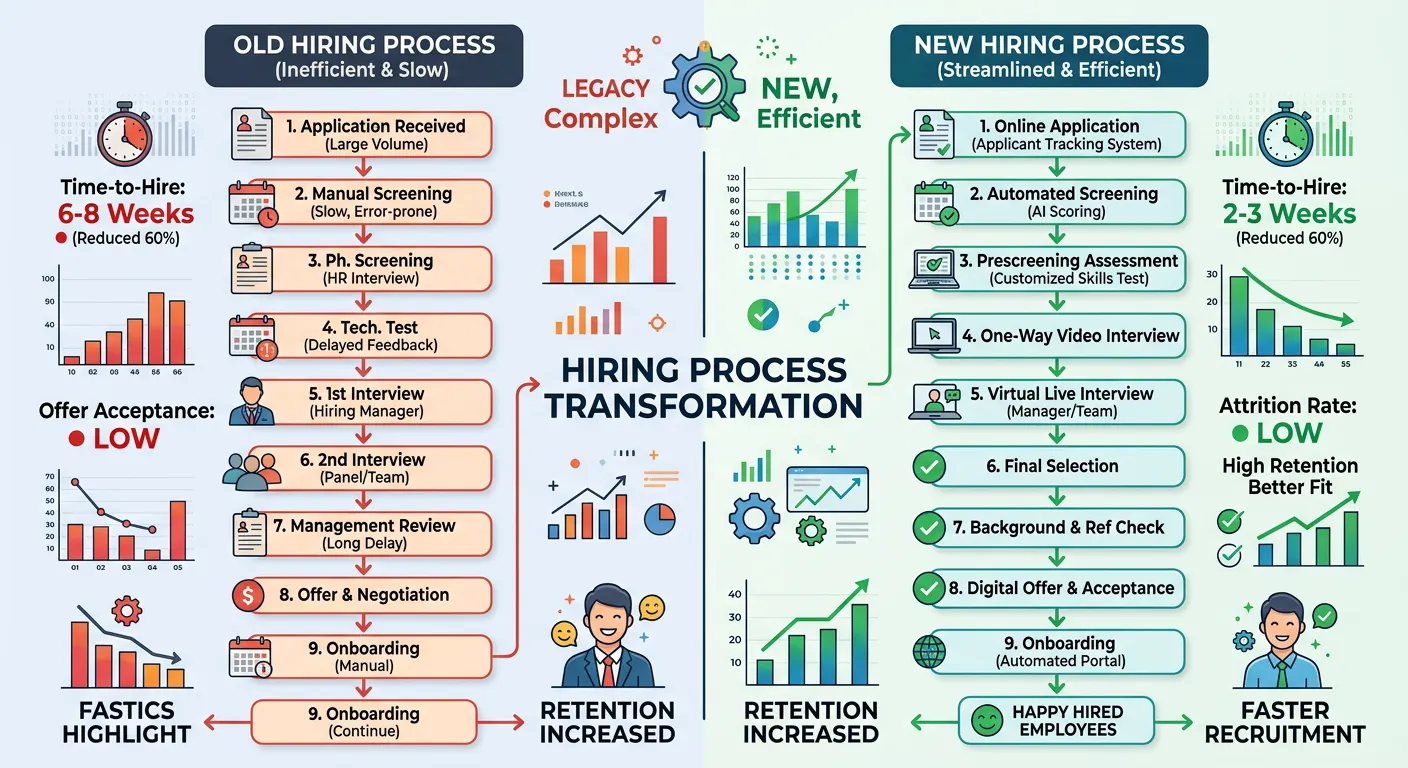
The Strategic Intervention
We implemented a three-pillar approach focused on how to optimize hire employees for this specific context:
- Redefined Role Blueprint: Analysis revealed that success depended less on Michelin-star experience and more on resilience in high-pressure, temporary environments, adaptability to changing menus, and teamwork. The job description was rewritten to reflect this.
- Structured, Scenario-Based Assessment: We replaced the traditional interview with a practical stage. Candidates were given a limited pantry and 30 minutes to prepare and plate a dish, simulating the pressure of a sudden menu change. This was paired with behavioral questions about handling equipment failures or difficult team members.
- Enhanced Onboarding & Realistic Job Previews: Before signing contracts, candidates were given a video"day in the life" tour and met virtually with a current team member. This set accurate expectations, a key tactic to find talent that would actually stay.
Reduction in 6-month attrition
Faster average time-to-fill
Increase in hiring manager satisfaction
This case demonstrates that a data-informed, human-centric redesign of the hiring process, even for traditionally high-turnover roles, yields dramatic results. The principles apply whether you're hiring for specialized offshore roles or volume warehouse positions.
Leveraging Data to Predict Hiring Success
Beyond tracking basic metrics, forward-thinking companies use predictive analytics in their candidate screening strategies for 2026. By analyzing data from past hires—their source, assessment scores, interview feedback, and subsequent performance—you can build models that identify which candidate attributes correlate with long-term success in specific roles.
For example, data might reveal that the most successful Warehouse Supervisors at your company didn't necessarily have the longest tenure in previous roles, but scored highly in a specific problem-solving simulation. This allows you to weight that assessment more heavily in future screenings.
Actionable Insight: The Talent Acquisition Dashboard
Implement a live dashboard that tracks your key hiring metrics. Monitor funnel conversion rates from application to offer for different job families (e.g., culinary vs. logistics). If you see a steep drop-off at the assessment stage for driving roles, it may indicate the test is too difficult or not properly aligned with the job's real requirements. This continuous feedback loop is essential to optimize hire employees processes.
Key Predictive Indicators to Watch
- Assessment Score vs. Performance: Correlate scores from skills tests with 90-day performance reviews.
- Source Quality: Which sourcing channel (referral, job board, social media) yields hires with the highest retention?
- Time-in-Stage Analysis: Identify bottlenecks. Does your process stall waiting for hiring manager feedback?
- Candidate Sentiment: Analyze feedback survey data to predict offer acceptance rates and improve experience.
The Unsung Hero: Employer Brand as a Talent Magnet
Your ability to find talent is intrinsically linked to how candidates perceive you as a place to work. In a transparent digital world, your employer brand is built and broken online every day.
Beyond the Careers Page
A compelling employer brand showcases your culture, values, and employee experiences authentically. It’s not just about stating you're a"great place to work"; it's about proving it.
- Employee-Generated Content: Encourage team members to share their stories. A video testimonial from a Head Chef about career growth is more powerful than any corporate brochure.
- Showcase Impact: How does your team contribute to the community or sustainability? Do you cater major charity events? This purpose attracts talent aligned with your values.
- Manage Your Digital Footprint: Proactively respond to reviews on sites like Glassdoor. Address concerns transparently and celebrate positive feedback.
For niche roles, tailor your brand message. When seeking an Inflight Chef, highlight the unique challenges and perks of working at 30,000 feet. For warehouse recruitment, emphasize safety culture, technology adoption, and career pathways from operative to supervisor. A strong, authentic employer brand acts as a pre-screening tool, attracting candidates who are already culturally aligned and more likely to succeed—making your subsequent candidate screening both easier and more effective.

